

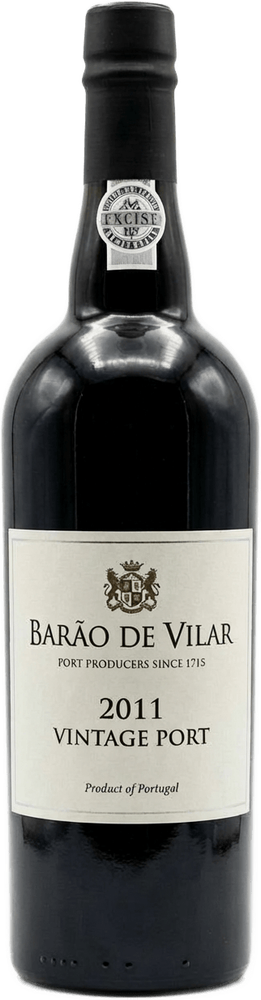
Vintage Port (2011)
SommeliAI Insights
Dense and opaque 2011 Douro Vintage Port, showing blackberry, cassis and black plum with a rich, tannin framed finish.
About this wine
Barão de Vilar Vintage Port 2011 is a classic Douro Vintage Port blend of Touriga Nacional, Touriga Franca, Tinta Roriz, Tinta Barroca, and Tinto Cão. It is made from manually harvested, very ripe grapes, with partial destemming, intense maceration during fermentation, and fortification with grape spirit to stop fermentation and keep natural sweetness. The wine then ages in large oak vats in the Douro with temperature and humidity control, and it was bottled about three years after harvest. It is bottled without stabilization or filtration, so it can throw a natural deposit in bottle. In the glass it is typically very dark and opaque, with concentrated aromas and flavors that lean to blackberry jam, cassis, and black plum, with notes that can suggest cocoa and an earthy edge. The palate is full and rich with a creamy texture, firm grape tannins for a Port, and a long, persistent, fruit driven finish.
About the grape
Barão de Vilar 2011 Vintage Port uses the classic Douro red mix of Touriga Nacional, Touriga Franca, Tinta Roriz, Tinta Barroca, and Tinto Cão, a blending tradition built to balance power, perfume, and long aging after fortification. Touriga Franca is now the most widely planted red grape in the Douro and is valued for reliable ripening and for giving shape and volume in Port blends, while Touriga Nacional is a naturally low yielding, thick skinned variety that producers lean on for concentration in declared vintage years. Tinta Roriz is the local Douro name for the Iberian variety known in Spain as Tempranillo, it ripens relatively early and is widely used in Porto lots for its firm structure and ability to perform across many vineyard sites. Tinta Barroca is largely associated with the Douro and is popular because it is straightforward to cultivate and tends to accumulate sugar early, while Tinto Cão is an old Douro variety with small bunches and late ripening that holds up well in heat and is often included in smaller proportions to support longevity in Vintage Port.
Quick facts
- 🏛️ 2011 is considered a landmark Vintage Port year and was one of the first broadly or universally declared vintages since 2007, putting this bottling in a collector celebrated “classic year” category.
- 🪵 This Vintage Port was aged in large oak vats in the Douro and bottled about 3 years after harvest, a tradition meant to lock in power and freshness early in its life.
- 🧭 It was not stabilized or filtered before bottling, so it can throw a natural sediment in bottle, basically a built in “treasure at the bottom” over time.
- 🦶 The grapes were hand harvested very ripe, then partially destemmed and worked with intense maceration in mechanical lagares before fortification, a modern take on a famous Port technique.
- 👑 Barão de Vilar is a van Zeller family house and its name traces to a noble title first granted in 1836, so the label is literally tied to Portuguese aristocratic history.
Palate profile
Producer
Barão de Vilar is a Douro and Port producer created by the van Zeller family, whose wine trade roots stretch back centuries and are often cited as an unbroken multi generation involvement in Port and Douro wines. The company Barão de Vilar, Vinhos SA was established in January 1996 by Fernando Luis van Zeller, built from an initial lot of wine passed to his sons Fernando and Álvaro. Its name revives the Barão de Vilar title granted in 1836 by Queen Maria II to Cristiano Nicolau Kopke, tying the modern firm to historic Port trade heritage. The house developed a strong base in Vila Nova de Gaia for ageing, bottling and logistics while growing its Douro footprint through properties in the Upper Douro such as Quinta do Saião in Vila Nova de Foz Côa. In recent years it has invested in expanded capacity including a new bottling center in Pedroso, and the group has adopted the corporate name Van Zeller Wine Collection SA while keeping Barão de Vilar as a key brand.
