

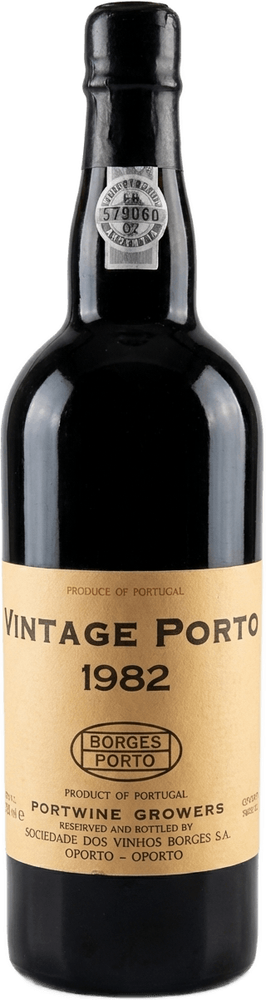
Vintage Port (1982)
SommeliAI Insights
Borges 1982 Vintage Port from Douro shows mature dried fruit, roasted nuts, toffee and cocoa, with a sweet, velvety palate and long finish.
About this wine
This is a traditional Vintage Port from Portugal’s Douro, fortified during fermentation with grape spirit to preserve sweetness and reach about 20 percent alcohol. The blend is led by classic Douro varieties, including Touriga Nacional, Touriga Franca, Tinta Barroca, and Tinta Amarela, often reported in equal or near equal proportions for this bottling. In the glass it shows a mature, tawny tinged ruby color, reflecting long bottle age since the 1982 harvest. Aromas lean toward dried red and black fruits, fig, and raisin, alongside walnut, cedar, and roasted coffee, with notes that can read as toffee or crème caramel as it opens. The palate is sweet and persistent, medium bodied for a Vintage Port of this age, with softened tannins, gentle acidity, and flavors of dried fruit, nut, cocoa, and warm spice. Like many well aged Vintage Ports, it can throw sediment, so careful standing upright and slow decanting are recommended before serving.
About the grape
Borges 1982 Vintage Port from the Douro is built from four traditional Port grapes, Touriga Nacional, Touriga Franca, Tinta Barroca, and Tinta Amarela, a classic kind of field blend mix that historically suited the region’s terraced vineyards. Touriga Nacional is a flagship Portuguese variety from the Douro and Dão, valued for its small thick skinned berries and naturally low yields, and in a Vintage Port like this it is used as the structural core from the best schist based sites. Touriga Franca, a later identified crossing of Touriga Nacional and Mourisco Tinto, became the Douro’s most planted workhorse because it crops more reliably and stays healthy in tough conditions, so it is often paired with Touriga Nacional to fill out the blend. Tinta Barroca is traditionally kept for cooler or north facing terraces because it can build sugar quickly in hot years, while Tinta Amarela, also known as Trincadeira, is an old Portuguese grape that is prized when fully ripe but is disease sensitive, so producers look for warm, dry, well ventilated parcels to make it work in a Vintage Port blend.
Quick facts
- 🏛️ Borges, the producer behind this 1982 Vintage Port, was founded in 1884 by the brothers António and Francisco Borges.
- 🧩 This 1982 is built from four classic Douro red grapes in an unusually even split, Touriga Nacional 30%, Tinta Amarela 30%, Tinta Barroca 20%, and Touriga Franca 20%.
- ⏳ It’s a true Vintage Port style that’s designed to mature in bottle, meaning this 1982 has had more than 40 years to evolve after bottling.
- 🛑 The wine is made by halting fermentation with grape spirit after a very short, intense ferment of about 3 to 4 days, locking in sweetness while keeping deep color and structure.
- ⛰️ Some technical sheets for this bottling point to old Douro vineyards averaging around 60 years, traditionally farmed on slate soils and steep terraces typical of the demarcated Douro region.
Palate profile
Producer
Sociedade dos Vinhos Borges S.A. was founded in 1884 by the brothers António and Francisco Borges, and grew from their early trading activity into a long standing Portuguese wine house. In 1918 the brothers separated the wine business into a dedicated company, helping Borges expand its focus on producing and marketing wines, including Port. Borges developed sparkling wine expertise early on, and launched the classic Fita Azul in 1934, which became a signature name for the house. Since 1998 Borges has been part of the JMV Group, a Portuguese owned group led by the Vieira family. Today the company supports its range with estate vineyards across key demarcated regions, including Vinho Verde, Douro, and Dão.
